
The Same Players, Two Gambling Markets
New British research documents the overlap between licensed and illegal gambling. Evidence from the Netherlands, Sweden and Malta raises further questions about how player protection works across accounts and websites.
A person can remain a customer of a licensed gambling operator while also using an illegal website. For the businesses and regulators trying to assess that person’s exposure to harm, activity in one account may reveal only part of the picture.
Research published by Britain’s Gambling Commission on 28 October gives that problem a concrete form. Among participants with repeated detected illegal gambling transactions, 91% also used licensed operators. The finding concerns a specific research sample, but it challenges the assumption that the two markets serve separate groups of people. 1
Following the money
The Commission examined anonymised banking records supplied with consent by 38,000 people, covering July 2018 to July 2026. Linking those records to earlier survey responses allowed researchers to examine transactions alongside information about the individuals involved. 1
They identified 3,426 transactions believed to involve illegal operators, made by 179 people. The analysis found no substantial withdrawal from licensed gambling after the first detected illegal transaction. The two forms of activity often continued alongside each other. 1
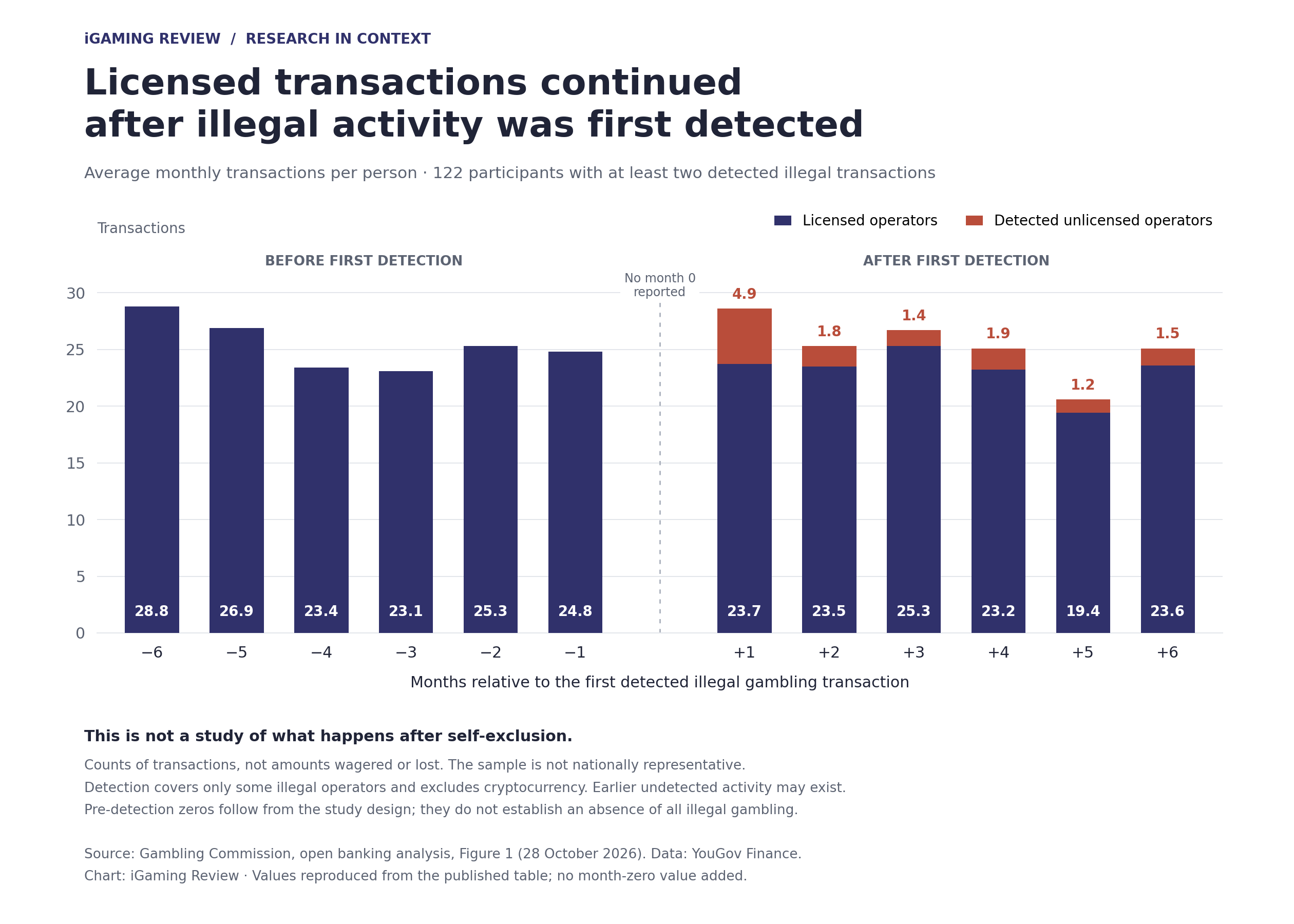
View chart data and methodology
| Month | Licensed | Detected illegal |
|---|---|---|
| -6 | 28.8 | 0.0 |
| -5 | 26.9 | 0.0 |
| -4 | 23.4 | 0.0 |
| -3 | 23.1 | 0.0 |
| -2 | 25.3 | 0.0 |
| -1 | 24.8 | 0.0 |
| +1 | 23.7 | 4.9 |
| +2 | 23.5 | 1.8 |
| +3 | 25.3 | 1.4 |
| +4 | 23.2 | 1.9 |
| +5 | 19.4 | 1.2 |
| +6 | 23.6 | 1.5 |
The published table reports months −6 to −1 and +1 to +6; it provides no month-zero value. Earlier zeros follow from the detection-based study design and do not rule out undetected illegal gambling. The sample is not nationally representative, only some illegal operators could be identified, and cryptocurrency payments were excluded. 1
There was also a marked difference in reported gambling problems. Among those with available survey scores, 45% of the group with detected illegal transactions scored eight or more on the Problem Gambling Severity Index, compared with 6% of the licensed, non-lottery gambling group in the dataset. Those groups can overlap. 1
These are comparisons within the sample. The panel was not nationally representative, cryptocurrency payments were outside the analysis, and the identification method captured only a subset of illegal operators. The study cannot establish the size of the illegal market or whether illegal gambling caused the higher levels of harm. A first detected transaction is also not necessarily someone’s first use of an illegal site. 1
Evidence of overlap beyond Britain
The Netherlands offers a second view, through a different measurement method. In a report released on 29 October, the Kansspelautoriteit estimated that around 10,000 people a month used both legal and illegal online gambling providers during the first half of 2026. 2
That estimate draws on GfK software tracking website and app use. The panel contained approximately 6,000 people, including around 300 identified online gamblers. The regulator explicitly cautions against placing too much weight on population estimates derived from small numbers of observations. 2
The Dutch estimate and British percentage cannot be compared directly: one extrapolates monthly participation from digital activity; the other examines detected bank transactions within a particular sample over several years. Their shared relevance is the presence of people in both categories. Any assessment that assigns each player exclusively to one market risks overlooking that overlap.
What draws people across
Banking records show payments; understanding decisions requires other evidence. A separate Gambling Commission report, published on 20 October and conducted by Yonder, combined a survey of more than 4,000 recent gamblers with qualitative research and analysis of online discussion. 3
It found that the phrase “not on GamStop” could mean more to users than a way around self-exclusion. Some associated it with fewer identity checks, faster withdrawals or payment options such as credit cards or cryptocurrency. The researchers also recorded users encountering familiar frustrations on illegal sites, including checks and difficulties withdrawing money. 3
These findings concern motivations and associations. They do not establish that a particular safeguard caused someone to use an illegal operator, or that weakening safeguards would reduce illegal gambling. Indeed, the wider sample expressed an appetite for more rules and regulation. 3
What self-exclusion can achieve
Evidence of circumvention needs to be read alongside evidence from people who value the protection.
Ipsos’s 2024 evaluation of GAMSTOP collected 4,651 survey responses and conducted 40 in-depth interviews. Seventy-eight per cent of respondents said the service had delivered the results they hoped for. This is a measure of users’ reported experience, rather than a verified rate of stopping gambling. 4
Among the 1,037 respondents who still gambled online, 34% reported using unlicensed or illegal operators. This subgroup included people whose exclusion had ended; multiple answers were allowed. The figure is not a percentage of all GAMSTOP users and does not establish that self-exclusion caused the activity. 4
The evaluation also has limits: respondents chose whether to participate, older users were overrepresented, and the findings relied on self-reported experience. The authors acknowledge that their approach does not provide definitive proof of causation. Even so, the reported benefits deserve a place in the assessment of self-exclusion. 4

A qualitative study by Lund University researchers adds detail from Sweden. Published in January 2025, it drew on interviews with 15 people who had used Spelpaus and reported gambling problems. Participants described relief from gambling and improvements in their lives, while also identifying access to overseas sites and the transition out of exclusion as concerns. They wanted clearer routes from self-exclusion into treatment and support. 5
Those interviews illuminate experiences; they do not establish how common each experience is among all Spelpaus users. The study was funded by Svenska Spel’s research council, and the authors state that the funder had no influence on its conduct or findings. 5
Protection across brands
The reach of a safeguard also depends on its implementation inside the licensed market.
In February, the Malta Gaming Authority published a review of 20 licensees and 58 active web addresses, based on mystery shopping conducted in the first half of 2025. Most assessed licensees were broadly meeting regulatory expectations. However, three allowed registration, deposits and play at another brand using identity details similar to those of a self-excluded player. 6
The exercise tested whether related brands could recognise the same person. It did not measure how many customers moved to illegal gambling. Its practical relevance is narrower: an exclusion can be undermined when an operator’s systems fail to connect accounts that should be linked. The MGA’s guidance specifies that exclusions related to problem gambling must extend across brands operating under the same licence. 6
Measuring what happens to the person
A record of an intervention is not, on its own, evidence that harm has fallen. Britain’s Gambling Commission already requires remote licensees within scope to assess the impact of their interactions and actions, the continuing risk of harm and the need for further intervention. Its guidance identifies a reduction in harm indicators following action as the key measure of effectiveness. 7
None of the evidence presented here establishes that self-exclusion itself causes migration to illegal gambling. It does show why effective protection cannot be assessed solely from activity inside a single account. Operators should demonstrate that the safeguards within their control work; broader evaluations should establish whether gambling shifts elsewhere and whether harm diminishes or persists. Claims of lasting protection require evidence about what happens to the person afterwards.
Sources and research notes
Checked 2 November 2026. Six principal research reports from five originating organisations or research teams, plus regulatory guidance from the Gambling Commission. Publication dates are distinguished from the periods studied. The final section is iGaming Review’s editorial interpretation of the evidence.
- Gambling Commission, Illegal gambling – Findings from an open banking data analysis, 28 October 2026. Results, materials and methods, limitations. The PGSI comparison uses 146 people with detected illegal transactions and 12,543 with licensed non-lottery gambling transactions; these are not mutually exclusive populations.
- Kansspelautoriteit, Monitoringsrapportage online kansspelen – Over voorjaar 2026, released 29 October 2026. Report, printed pp. 3, 13 and 17; publication announcement. Weighted estimates from a non-random GfK panel, not a count of all Dutch players.
- Gambling Commission / Yonder, Illegal online gambling: Phase 3 – Understanding push factors for consumer engagement with illegal gambling websites, 20 October 2026. Executive summary. Survey participants had gambled in the previous four weeks; lottery-only players were excluded.
- Ipsos, GAMSTOP Evaluation Report, 2024. Report, printed pp. 3, 9, 11–13 and 30–31. The report describes fieldwork in April–June 2024 despite “2023” appearing in its filename and footer. A service evaluation published by GAMSTOP; it should not be treated as a controlled clinical trial.
- Johanna Tjernberg, Sara Helgesson, Anders Håkansson and Helena Hansson, Lund University, Exploring the Users’ Perspective of the Nationwide Self-Exclusion Service for Gambling Disorder, “Spelpaus”: Qualitative Interview Study. JMIR Human Factors, 31 January 2025, 12:e66045. Paper. Small qualitative study; funding disclosure discussed in the article.
- Malta Gaming Authority, Player Protection: Self-Exclusion Practices in the Online Gaming Sector – Thematic Review, released 17 February 2026. Report, printed pp. 10, 15–16 and 23; publication announcement. Targeted supervisory testing; the findings are not a sector-wide failure rate.
- Gambling Commission, Customer interaction guidance for remote gambling licensees, Section D: Requirement 12 and Requirement 13. Guidance issued August 2023, effective 31 October 2023. Applies to licensees within the scope of Social Responsibility Code Provision 3.4.3; it does not establish an operator’s ability to observe all gambling at unrelated providers.
Related reading: How Big Is the Gambling Black Market? A Global View of the Estimates.