
INTERVIEW SEPTEMBER 2026
Interview with Claudia Heiling: Technology Must Create Practical Value
Golden Whale's co-founder on why three former Greentube colleagues reunited to build a machine learning company, and why she thinks of her own job as the oil in the gearbox.
Interview
Our editor had a conversation with Claudia Heiling, Co-Founder and Chief Operating Officer of Golden Whale, about the reunion of three former Greentube colleagues, the founding bet that player data had outgrown manual decision-making, and the questions she believes every operator should ask before signing up to an AI solution.
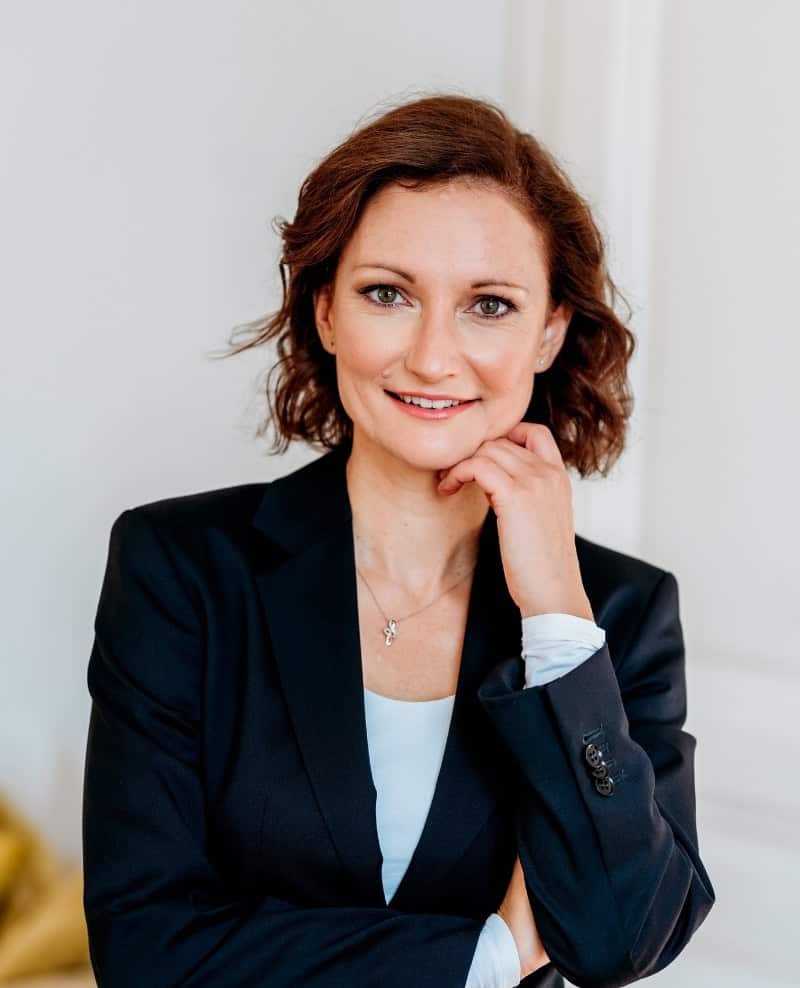
Claudia Heiling, Co-Founder and Chief Operating Officer, Golden Whale. Image courtesy of Golden Whale.
Box-out: Claudia Heiling, Co-Founder and Chief Operating Officer at Golden Whale
Current Title: Co-Founder and Chief Operating Officer
Company: Golden Whale
Focus: Product, customers and operation. Instrumental in multiple market entries of games and portals for B2C/B2B customers, played by millions of users.
Education: Master's degree in information management.
Background: At Greentube, Heiling grew with the company to around 400 people across B2B and B2C markets, including the opening of Greentube's first licensed market, in Italy.
Missing the Vibe of the Industry
Heiling loved playing games as a child, and played PC games early — an enthusiasm that predates her career by years.
She started her career at Greentube, where she spent ten years, joining when the company was still connecting people over the internet in the early 2000s. She describes it as a great start precisely because of its breadth: she remembers going through different verticals at Greentube, from skill games to social casino and eventually iGaming – a period of significant growth and international expansion during which the Golden Whale's future founders worked together.
She eventually left Greentube for a career in other fields. What she found, once she was outside the industry, was that she missed it. “I was missing the vibe of the industry,” she says — the speed, the growth opportunities, the international scope, and the sense that things were always moving.
Heiling also believes in the power of a diverse team, in every sense of the word: skills, personality, and viewpoints combining into a strong, solid core. She felt she had that at Greentube, which is part of why, when Dürrschmid, the original founder of Greentube, asked Kolbabek and her to join a new venture, she said yes, aware it would be a challenge. All three had left Greentube at different points and ended up circling back to the same idea at the same time. Heiling calls it serendipity.
“Eberhard's argument was that the amount of player data this industry generates had exploded to the point where you simply cannot analyse it manually anymore,” Heiling says of Dürrschmid's founding argument for Golden Whale. “His vision was to move away from slow, manually run CRM campaigns and towards decision-making that machines run automatically.”
Heiling frames her own COO role in more operational terms. “I see myself as the oil in the gearbox,” she says — the person responsible for aligning people, removing friction, and making sure nothing gets left behind as strategy turns into execution. “I'm a roll-up-your-sleeves kind of person, and I think it matters that everyone on the team owns their own topic.
I am responsible for this task, and if I can't get further, I need to ask.”
Golden Whale was founded after the outbreak of Covid-19, which meant it worked remotely from the outset. Heiling says that model requires trust, and the team is kept broadly across Europe and within a similar time zone to make it work, with physical workshops roughly once a quarter.

Claudia Heiling presents Golden Whale's team at the New iGaming Customer Experience Summit, organised by WBR. Image courtesy of Golden Whale.
From Retrospective and Subjective to Predictive
Golden Whale's argument is that the industry generates more behavioural data than any human team can meaningfully interpret, but that machine learning can find patterns humans cannot hold in their heads. “The machine excels in finding the right point to deliver the right offer to each person at the right time,” Heiling says, with what she describes as a layer of human oversight sitting above it. In her account, that shift frees creative teams to spend their time on how a brand speaks to its customers, rather than on manually deciding who receives which offer and when.
“We don't ask operators to change their existing systems,” Heiling says. “Our decision-making modules sit alongside and on top of their infrastructure, not instead of it.”
Onboarding a new client starts with a technical session between the two CTOs, which Heiling says can take as little as 30 minutes. From there, Golden Whale works with as much raw player data as the operator can provide.
That data feeds decisions that Heiling says used to be retrospective and subjective — CRM and bonus decisions made after the fact, based on judgement. Golden Whale's argument is that those decisions have become predictive instead, with patterns in the data used to determine when to give what to whom.
“As an operation, you have multiple ways of engaging with your customer,” Heiling says. “You have a CRM, you have a loyalty programme, you have a gamification tool — so many ways to speak to your clients. The real question is how you orchestrate all these activities to really engage with your players and your customers at the right point in time.” Golden Whale's technology layer, Foundation, with a product called Bonus Pilot built on top, is designed to answer exactly that question. “It tells you when to give what to whom, in what amount,” she says.
Bonus Pilot officially launched in January 2026 and has since been rolled out to multiple operations globally. Asked what still surprises her about how operators and players behave, even after years of working with this data, Heiling points to Bonus Pilot's findings: according to Golden Whale, only 5–15% of incentives are typically deployed in an optimal way — this is Golden Whale's own assessment based on re-engineering data from operations across four continents. Golden Whale's models behind these numbers continue to improve as they produce more meaningful results.
Industry perspective
“Technology must create practical value.”
— Claudia Heiling, Co-Founder and Chief Operating Officer, Golden Whale
Three Questions for an Operator Before They Consider an AI Solution
Heiling frames her advice to operators as three questions worth asking before signing anything.
How do you measure success?
“What are the KPIs that are actually telling us this works, and that it's worth both our efforts and money?” Heiling says. “I would definitely ask any new supplier about their benchmarking activities, how they measure impact, and how they continue to do so even after a proof-of-concept phase.” Her reasoning: “everything is new and shiny in the beginning, but it's all about the results in the end.” Her advice is to ask how bespoke the solution is to your operation, and how results are being measured.
“There are KPIs that everybody looks at, like increase in wager, activity, or deposits,” she says, “but they can be very bespoke to the operation and the phase that operation is in at the moment. Am I in a growth stage, or am I here to stabilise my market share? In the end, it's about finding a solution that fits your current phase and your goals.”
Could this solution benchmark against, or outperform, what you're already doing in-house?
That is her second question, asked from the buyer's side. “And if so, how much?” she says.
What would success actually look like twelve months in?
“If you've worked with us for twelve months, you will most likely have come to the conclusion that what we promised has materialised for your business,” Heiling says, “that your KPIs actually improved over the course of time. Using Golden Whale is the fastest way to see results with AI when it comes to optimising retention.” She also points to a newer area of development at the company: “we're one of the fastest ways to access user acquisition funding too — that's a new part we've just been developing.”
Heiling places Golden Whale's own founding before the current wave of generative AI attention, describing it as a pre-ChatGPT company. Asked about competition, her answer is not about rival vendors. “No one builds their own databases anymore,” she says. In her framing, the contest is less about who owns the infrastructure and more about who turns it into a usable decision fastest. This autumn, Golden Whale is launching a new self-service product, intended to lower the barrier to using its technology at all.
Whether that contest produces meaningfully different outcomes between vendors, or converges the way CRM technology itself once did, is a question the next few years of the industry will answer. For Heiling, the appeal of working in it hasn't changed: the industry, she says, is still open to innovation.
Article written by Elisabet Johansson
Further Reading & Key Sources
iGaming News, June 2026: Ladies Who Launch: From Industry Experience to Entrepreneurship — Claudia Heiling on Building Golden Whale
AI Match Sessions, YouTube: What an AI Decision Layer Actually Solves — Claudia Heiling, Golden Whale