
Coolbet and the Cost of Building a B2B Gambling Business
Business · Analysis · 3 November 2026
Proposed job cuts in Tallinn put a human cost on a wider business problem. Sega Sammy’s disclosures show why a successful consumer betting operation does not automatically translate into a profitable technology supplier.

Coolbet’s restructuring places 131 positions at VG Estonia OÜ potentially at risk. COO Tomas Graham told NEXT.io on 30 October that a collective redundancy consultation was expected to continue through November; an exact end date had not been confirmed. The figure describes proposed changes, not completed dismissals. 1
For the people affected, the immediate issue is their employment. For the wider industry, the case also raises a question that reaches beyond one company: what does it take to turn technology built around a betting business into a sustainable business serving other operators?
Sega Sammy’s Integrated Report 2026, published on 2 November, provides an unusually clear starting point. It describes GAN’s consumer business, operated through Coolbet, as solid, while its B2B activities, including the platform business, are loss-making. That distinction matters when assessing a restructuring associated with the Coolbet name. 2
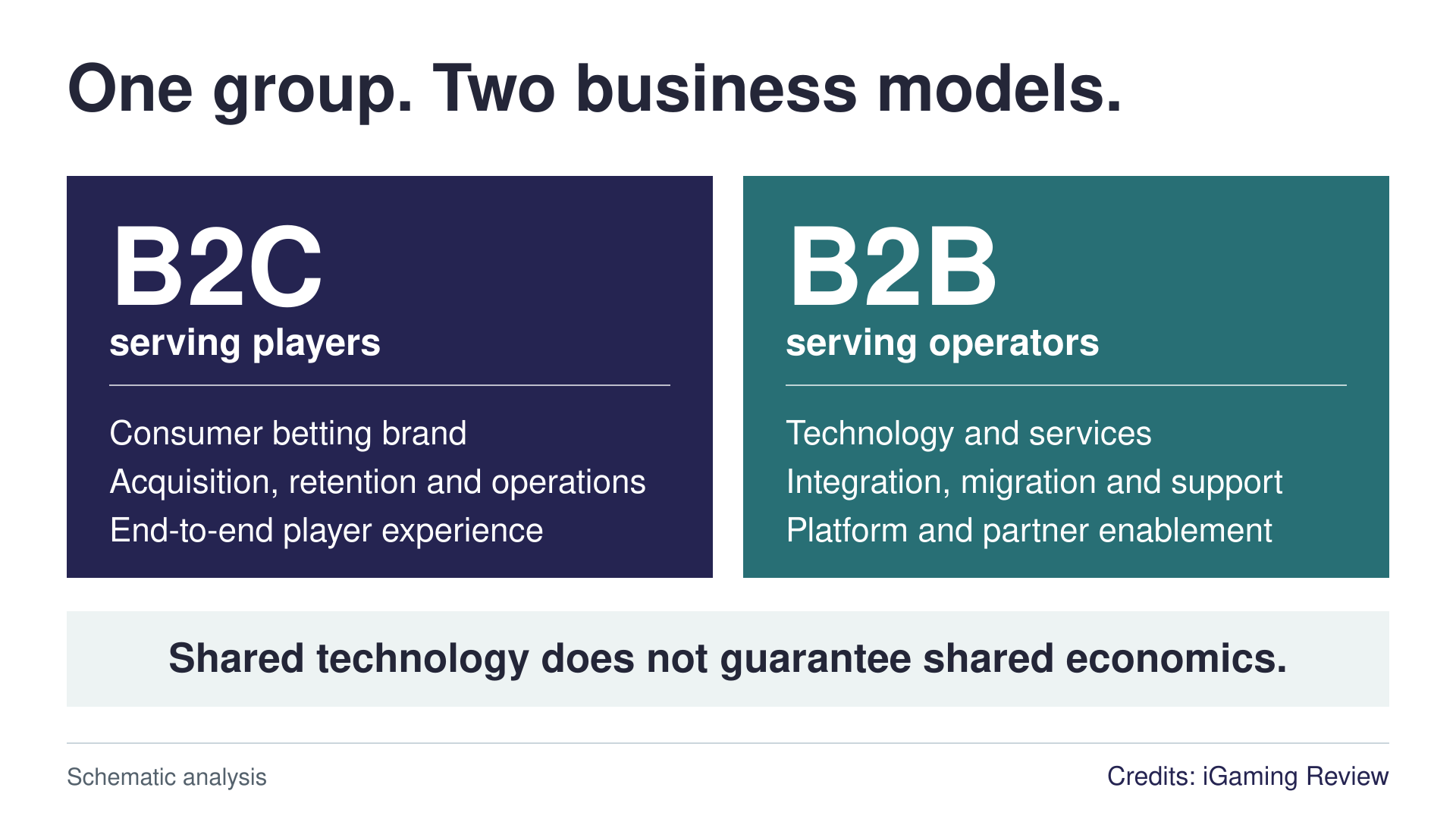
Two businesses inside the same organisation
GAN’s acquisition of Coolbet, announced as completed in January 2021, had an explicit technological rationale. Alongside the consumer operation, GAN was buying a proprietary sportsbook engine to integrate into its offering for other gambling operators. Sega Sammy subsequently completed its acquisition of GAN on 27 May 2025. 3, 4
The distinction between the two models is straightforward. A consumer operator serves players. A B2B supplier serves businesses that must, in turn, serve their own players. GAN’s historical segment disclosures identify Coolbet’s online sportsbook and casino within B2C, and platform, sportsbook and back-office technology sold to operators within B2B. 5
The organisational boundary is less tidy. Technology developed within a consumer business can support external clients; engineers and operational expertise can contribute to both. The acquisition rationale itself depended on that overlap. Treating every Coolbet-related activity as purely consumer-facing would therefore obscure the business Sega Sammy inherited. 3
The commercial challenge is that a product used by one operator becomes a service obligation when other operators depend on it. A supplier must decide which client requests belong in a common product, which require additional work, and how that work will be paid for. An expanding customer list can bring revenue while also increasing the number of commitments the supplier must support.
The expense of an unfinished transition
At its June management meeting, Sega Sammy identified parallel operation of V1 and V2 platforms, delayed migration, dispersed resources and high fixed costs at GAN. It also said integration after GAN’s Coolbet acquisition had fallen short. This was management’s diagnosis months before the Tallinn consultation. 6
The savings from a migration depend partly on what the business can stop maintaining. Launching a replacement platform creates a new capability; retiring the old one removes an obligation. Between those events, an organisation can be paying for development of the future system and continued operation of the existing one.
That makes the completion of a migration a commercial milestone as well as a technical one. The useful test is whether clients are successfully operating on the replacement, service remains dependable, and the legacy workload can actually end. Counting releases or announcing a new platform tells readers much less about the cost that remains.
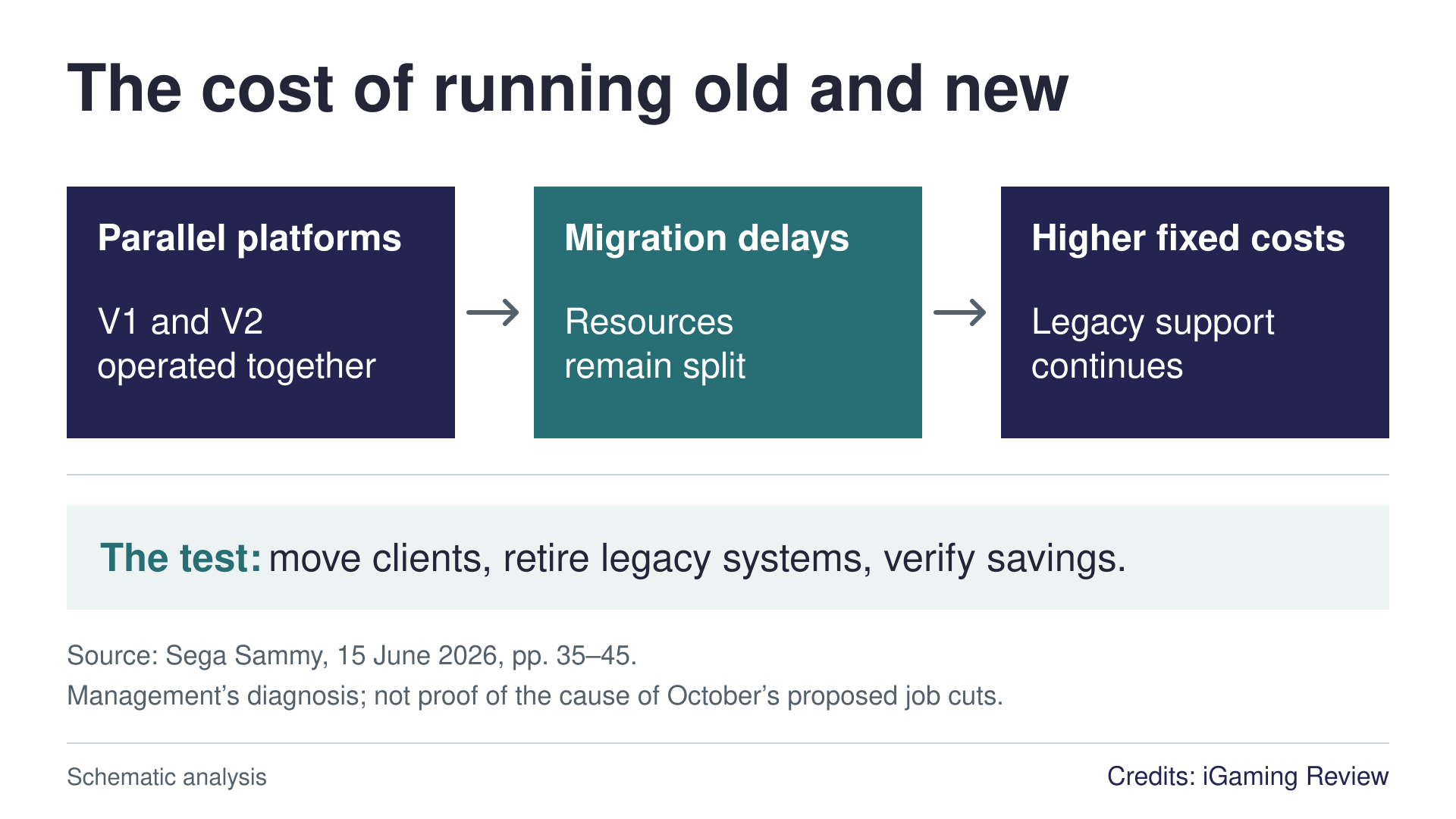
The November integrated report reiterates the proposed direction: migration to V2, a review of the organisation and fixed costs, and restructuring of unprofitable businesses. It presents lower operating costs as an expected benefit of the platform transition. That is a plan whose results still need to be demonstrated. 2
Revenue is an incomplete scorecard
The June presentation prioritises the turnaround over short-term client counts or revenue. A contract can enlarge a supplier’s business without improving its underlying economics. 6
GAN’s earlier public accounts illustrate why the choice of metric matters. Its 2024 segment reporting used “segment contribution”, a measure that excluded several expenses, including product and technology, sales and marketing, general and administrative costs, and depreciation and amortisation. A positive figure on that basis could not, on its own, establish that a segment covered the full cost of running it. Those historical disclosures explain the metric; they are not evidence of current margins. 5
Nor should the financial condition of the consumer operation be inferred from a group-wide loss. In the Q&A from its May 2026 results briefing, published in June, Sega Sammy explicitly described GAN’s B2C business as already profitable while discussing improvements needed in B2B. The November report preserves the contrast between a solid consumer operation and loss-making B2B activities, without supplying a separate current profit margin for each in that discussion. 7, 2
The analytical task is to follow the costs to the activity that creates them. For a supplier, that means looking beyond contract value to implementation, continuing support and the development commitments needed to retain the account. For a buyer, it means understanding whether the supplier can deliver its roadmap while maintaining the service on which the buyer already depends.
What the Tallinn proposal does—and does not—establish
Coolbet has cited several pressures behind the proposed restructuring, including weaker-than-expected B2B results and regulatory and tax pressures across markets. Graham also said the headquarters would remain in Tallinn and that the proposal did not arise from anything specific to Estonia as a gambling market or operating location. 1
Those statements provide the company’s explanation. They do not provide a confirmed breakdown of proposed reductions by activity, quantify the savings they would produce, or demonstrate that any single platform issue caused them. The consultation’s outcome remains unresolved.
The June disclosures and the October proposal belong in the same analysis, but they answer different questions. One sets out management’s diagnosis of a business; the other concerns proposed changes to jobs. Linking the two is useful context. Treating the earlier diagnosis as proof of the necessity or eventual success of every proposed reduction would go beyond the evidence.
A more useful test of progress
The wider lesson is about execution. Shared ownership gives businesses the opportunity to combine technology and expertise. The economic benefit depends on whether that combination reduces duplication, supports dependable service and produces contracts that cover the work required to fulfil them.
For operator buyers, the practical response is to examine migration milestones, support capacity and responsibility for service continuity when assessing a platform partner. For suppliers, it is to measure client economics after implementation and continuing service costs, alongside the legacy systems that remain in operation. For owners, it is to distinguish forecast savings from costs that have demonstrably left the business.
Coolbet’s consultation has yet to establish its final employment outcome. For the wider business, the tests are completed migrations, reliable delivery and sustainable earnings. How the company treats affected employees, and whether it retains the expertise needed to serve customers, also matter to the outcome.
Sources and research notes
- NEXT.io, “Coolbet puts 131 roles at risk at Tallinn HQ amid B2B struggles”, 30 October 2026. Direct comments from COO Tomas Graham; proposed positions and consultation timetable, not completed redundancies. Cross-checked against ERR’s interview-based report, 29 October, which distinguishes the COO’s approximate figure from a separate report of 134.
- Sega Sammy, Integrated Report 2026, Growth Strategy, pp. 48–49; publication notice, 2 November 2026. Current management account of GAN’s B2C/B2B performance and turnaround priorities. References to earlier workforce reductions are not treated here as confirmation of the October Tallinn proposal.
- GAN, acquisition completion announcement filed with the SEC, 4 January 2021. Original rationale for combining Coolbet’s consumer operation and sportsbook technology with GAN’s B2B offering.
- Sega Sammy, GAN acquisition completion notice, 28 May 2025. Completion date: 27 May 2025.
- GAN, segment reporting note, six months ended 30 June 2024. Historical business definitions and the scope of segment contribution; not used as current financial results.
- Sega Sammy, Gaming Business Management Meeting presentation, 15 June 2026, especially pp. 35, 44–45. Management’s diagnosis and proposed response; turnaround targets are not treated as achieved results.
- Sega Sammy, full-year results briefing Q&A, p. 5, published 5 June 2026; briefing held 12 May.
Reporting checked to 3 November 2026. Business implications and the schematic illustrations are iGaming Review’s analysis of the cited disclosures. The diagrams do not quantify costs or allocate the proposed job reductions.